Why Founders, Freelancers, and Entrepreneurs Are Quietly Making Goa Their Professional Base — And Whether the Move Still Makes Sense
There’s a line in Ratan Tata’s most quoted interviews that has always stuck with entrepreneurs who’ve made unconventional decisions: “I don’t believe in taking the right decisions. I take decisions and then make them right.”
For a growing number of founders, consultants, and creative professionals across India and the NRI community, that decision is Goa. Not as a holiday. Not as a phase. As a deliberate, considered business address.
But the honest question remains: is starting or relocating a business to Goa still a smart move in 2026, or has the window already passed?
The answer is more nuanced than most articles will tell you. Let’s look at it properly.
Why Entrepreneurs Are Choosing Goa as a Business Base
The Shift from Lifestyle Move to Professional Strategy
Five or six years ago, moving to Goa was almost entirely a personal decision. People came here to slow down, recover from burnout, find some distance from cities that ran on caffeine and chronic overwork.
That framing has changed.
Today, professionals who choose to start a business in Goa aren’t choosing between their career and their quality of life. They are choosing a different architecture for how those two things coexist.
Work still happens. Deadlines still exist. Clients in Mumbai, Dubai, London, and Singapore still expect results — and rightly so. But the environment stops working against you.
You don’t spend two to three hours a day in gridlocked traffic. You don’t arrive at your desk already depleted. You don’t need to recover from your morning before your actual thinking can begin.
This might sound like a soft benefit. It isn’t.
Research consistently links chronic environmental stress, decision fatigue, and cognitive overload to poor business judgment, higher employee turnover, and accelerated founder burnout. When your baseline is calmer, your bandwidth expands. You think more clearly. You act less reactively. You build more deliberately.
For founders, that’s not a lifestyle upgrade. That’s a strategic advantage.
The Goa Startup Ecosystem in 2026: Honest Assessment
What the Ecosystem Offers vs. What It Doesn’t
Let’s be direct: Goa is not trying to compete with Bangalore or Gurgaon. It doesn’t need to.
The Goa startup ecosystem operates on entirely different logic — and understanding that logic is the difference between a successful relocation and a disappointed one.
It is smaller. More personal. Significantly less transactional. And for a specific kind of founder, that’s precisely the point.
Spend a few months here and you’ll find yourself in the same rooms as the same founders — at co-working spaces, informal networking events, rooftop gatherings that don’t feel like networking at all. Conversations happen organically. Introductions require less effort. Collaboration feels genuinely accessible rather than performative.
This environment consistently benefits early-stage entrepreneurs and independent operators more than sprawling metro ecosystems where everyone is perpetually rushing toward the next pitch.
What the Goa startup ecosystem does well:
Cost of Running a Business from Goa: Real Numbers
Rental & Office Space Costs (2026 Data)
There’s no point being dishonest about this. The cost of living in Goa has increased — meaningfully so in certain areas. Rental prices in popular zones like Assagao, Anjuna, Siolim, and parts of Panjim have risen considerably over the past three to four years.
Anyone telling you Goa is still as affordable as it was in 2019 is working with outdated numbers.
That said, when placed alongside comparable quality-of-life metrics in Bangalore, Mumbai, or Delhi — Goa remains substantially more cost-effective for the kind of professional life most founders are trying to build.
Operational Overhead vs. Metro Cities: Why It Matters More Than You Think
For early-stage founders, this cost differential is not just a comfort metric — it’s a runway metric.
Lower monthly operational overhead means more months before you need to make a revenue-or-die decision. It means more space to build thoughtfully rather than reactively. It means fewer desperate pivots made under financial pressure.
In the startup world, the difference between a company that survives its first two years and one that doesn’t is rarely the idea. It’s almost always the runway. And Goa, even at 2026 prices, extends that runway meaningfully compared to operating from a metro.
Which Business Models Thrive in Goa (And Which Struggle)
This is where people most commonly misunderstand Goa as a business base.
It is not universally ideal. No location is. The honest answer is that Goa suits specific types of businesses extremely well — and others poorly.
Business Models That Consistently Work Well
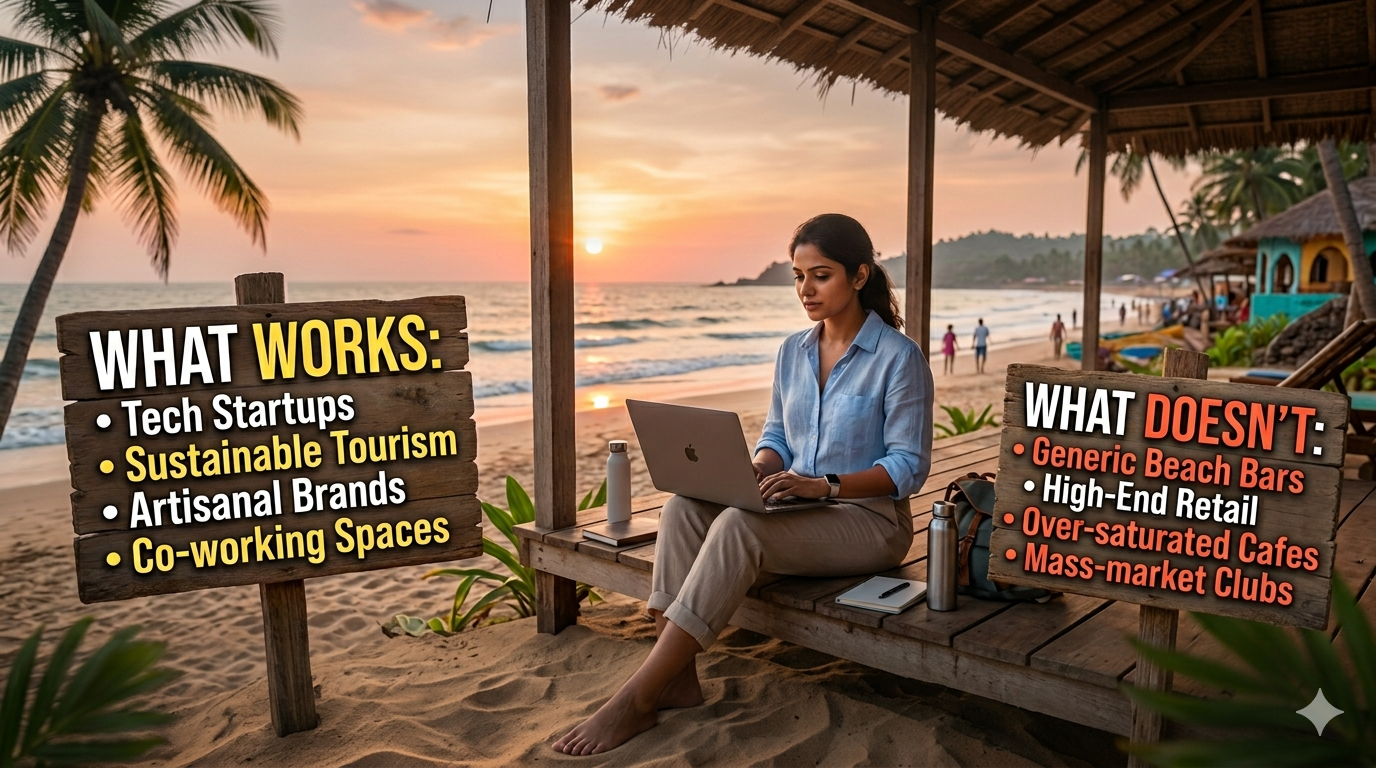
Digital and creative services — Design agencies, content studios, performance marketing firms, video production companies, and branding consultancies operate extremely well from Goa. Lower overhead, a creative environment, and access to a growing community of like-minded professionals make this a natural fit.
Consulting and advisory practices — Independent consultants, management advisors, strategy professionals, and executive coaches serving clients remotely find Goa an ideal base. The work is location-independent; the environment actively supports better thinking.
Remote-first startups — SaaS products, digital platforms, and tech-enabled services with distributed teams have no meaningful disadvantage operating from Goa. Many founders report improved focus and decision quality.
Boutique hospitality and experiential businesses — This almost goes without saying. Goa’s tourism economy creates genuine opportunity for well-positioned hospitality concepts, curated stays, wellness retreats, and experience-led businesses.
Independent professional practices — Lawyers, architects, financial advisors, and other licensed professionals serving national or international clients increasingly find Goa a viable and preferable base.
Business Models That Face Real Friction
Manufacturing and industrial operations — Infrastructure limitations are real. Don’t expect metro-equivalent logistics, supplier networks, or industrial utilities.
Large-team businesses requiring local hiring — Goa’s talent pool for specialized technical roles is limited. This is solvable with remote teams, but requires planning.
Businesses dependent on in-person institutional clients — If your client relationships require frequent face-to-face meetings with corporate entities, the travel overhead from Goa adds up quickly.
North Goa vs. South Goa: Where Should You Base Your Business?
This distinction matters significantly more than most relocation guides acknowledge — and it’s worth thinking through carefully before you commit to a location.
North Goa: Infrastructure, Energy, Accessibility
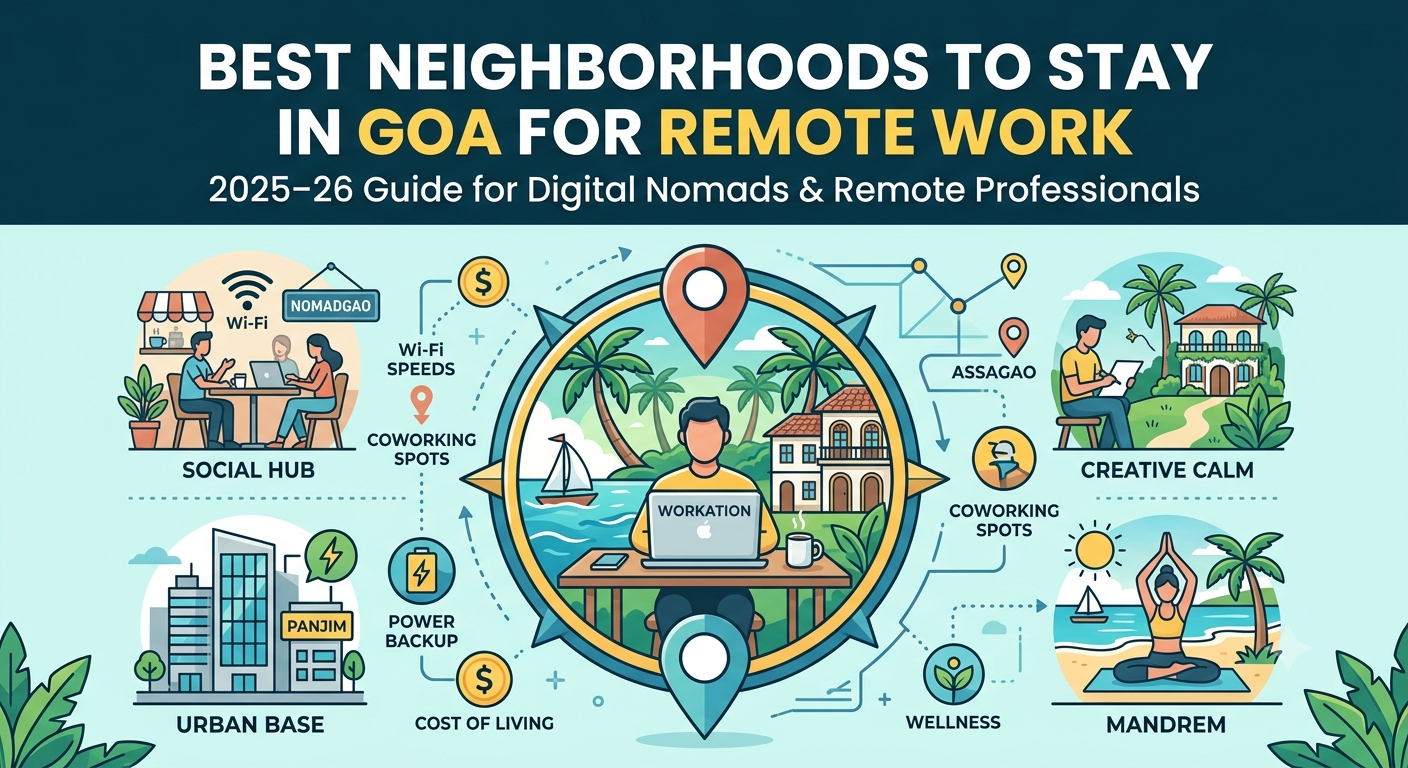
Panaji, Porvorim, Mapusa, and the coastal corridor through Calangute and Anjuna represent Goa’s professional nerve center. Co-working spaces are more plentiful and better equipped. Professional service providers — lawyers, accountants, consultants — are more accessible. The energy is higher, the pace faster, and the professional community more visible.
If you’re building a business that benefits from ambient energy, regular in-person collaboration, or proximity to Goa’s commercial and government infrastructure, North Goa is almost certainly the right base.
South Goa: Quiet, Focused, Intentional
Margao, Palolem, Agonda, Benaulim, and the broader south operate at a fundamentally different pace. Quieter. Less commercially intense. Better suited for deep, focused work — the kind of thinking that good strategic decisions actually require.
Many founders who have tried both report that South Goa is where their best work happens, even if North Goa is where their professional life is more visible.
The honest answer: neither is objectively superior.
Choose based on your working personality and your business type. Some founders need ambient energy to stay motivated. Others need silence to do their best thinking. Goa — unusually — offers both, within the same state.
The Real Challenges of Running a Business from Goa
Honest coverage of this topic requires acknowledging the limitations without either dismissing them or overstating them.
Talent Acquisition
Hiring locally for specialized roles — software engineers, senior designers, experienced marketing professionals — is genuinely difficult in Goa. The local talent pool for niche technical positions is limited compared to major metros.
The solution most founders use: build distributed remote teams. Hire talent from anywhere, base operations in Goa. This has become standard practice among Goa-based businesses rather than an awkward workaround. Remote-first team structures are well-established; Goa’s infrastructure supports them.
Pace of Operations
Things move differently here. Some administrative processes, government interactions, and vendor relationships operate at a pace that would be unrecognizable to anyone coming from a metro environment.
This is worth being realistic about — particularly for founders accustomed to Mumbai or Delhi operational rhythms.
The counterintuitive finding: many entrepreneurs report that while certain administrative tasks take longer, their overall business progress improves in Goa. They make better decisions because they’re making them from a clearer mental state. The quality of strategic thinking improves even when the pace of tactical execution slows.
Urgency and efficiency are not the same thing.
Infrastructure Gaps
Internet connectivity has improved substantially across popular areas of Goa. Co-working spaces offer enterprise-grade connectivity. But outside established zones, infrastructure can still be inconsistent. Power interruptions, while less frequent than a few years ago, remain a reality in some areas.
Plan around these rather than being surprised by them.
How BizGoa Helps You Navigate the Goa Business Ecosystem
One of the most underestimated challenges of relocating a business isn’t the business itself.
It’s navigating an unfamiliar professional ecosystem without reliable guidance.
Who are the credible legal professionals in Goa? Which consultants have genuine track records? Which accountants understand the specific requirements of businesses operating from Goa with national or international clients? Which service providers can you actually trust?
These questions — which seem secondary — consume enormous time and mental energy when you’re entering a new business environment without local context. The wrong answer to any of them can be expensive.
This is precisely where BizGoa delivers practical value.
By connecting entrepreneurs and relocating professionals with verified, credible businesses and service providers already established within Goa’s ecosystem, BizGoa reduces the uncertainty that slows relocation decisions and inflates their cost.
It shortens the learning curve. It reduces the risk of expensive missteps. It helps founders spend less time figuring out who to trust — and more time building what they came here to build.
For anyone seriously considering starting or relocating a business to Goa, having that kind of local intelligence — curated, accessible, and trustworthy — is not a convenience. It’s a meaningful competitive advantage.
Is Goa Still Worth It in 2026? Final Verdict
Here is the honest answer.
Yes — conditionally, but genuinely, yes.
The condition is alignment. Your business model, your working personality, your expectations, and your definition of success need to be compatible with what Goa actually is.
Goa is not a shortcut. It is not a passive income fantasy wrapped in sunshine and sea breeze. It is not a place where ambition automatically softens or standards automatically lower.
It is a location that supports sustainable, focused entrepreneurship better than most alternatives available to Indian and NRI professionals today.
If your work allows location flexibility, Goa offers something that extends well beyond cost savings. It offers longevity. Cognitive clarity. The space to think at the pace that good business decisions actually require.
It offers a professional community that is smaller than Bangalore’s but more accessible. More human. Less performative.
And increasingly, it offers what most emerging business ecosystems take decades to develop: a real community of people doing serious work, living intentionally, and building for the long term — not as a temporary experiment, but as a considered choice.
For many founders and entrepreneurs in 2026, that combination is worth considerably more than scale alone.
Frequently Asked Questions
Is Goa a good place to start a business in 2026?
Yes — particularly for digital services, consulting, creative agencies, and remote-first startups. Lower operational costs, a growing professional ecosystem, and exceptional quality of life make it a strong choice for founders and professionals with location flexibility. The key condition is that your business model supports location-independent operations.
What types of businesses work best in Goa?
Digital agencies, consulting practices, boutique hospitality, creative studios, SaaS businesses, independent professional services, and remote-first startups consistently perform well. Businesses requiring large local technical teams, manufacturing infrastructure, or constant in-person institutional client access face more meaningful friction.
How much does it cost to run a startup from Goa in 2026?
Significantly less than major metro cities. Co-working desks range from approximately ₹5,000–₹15,000 per month. Private offices for small teams run ₹25,000–₹60,000 monthly. Residential rentals, while higher than five years ago, remain 30–50% lower than equivalent options in Bangalore or Mumbai.
Can non-Goan residents legally register and operate a business in Goa?
Yes, without restriction. There are no state-level barriers to business registration or operation for Indian nationals or NRIs. Companies register under standard MCA procedures, which apply uniformly across India. Goa follows the same Companies Act framework as every other state.
Is North Goa or South Goa better for running a business?
North Goa — particularly Panaji, Porvorim, and Mapusa — offers denser professional infrastructure, more co-working options, and greater proximity to government and commercial services. South Goa is quieter, better suited to deep focused work, and preferred by founders who prioritize cognitive clarity over professional visibility. Neither is universally superior; the right choice depends on your working personality and business type.
What are the biggest challenges of operating a business from Goa?
Hiring locally for specialized technical roles is the most consistently cited challenge. Some administrative processes move more slowly than in metro environments. Infrastructure outside established zones can be inconsistent. Most founders address hiring by building distributed remote teams, which has become standard practice rather than a compromise.
How does BizGoa help entrepreneurs who are new to Goa?
BizGoa connects entrepreneurs and relocating professionals with verified local businesses, professional service providers, and operational partners already established within Goa’s ecosystem. This reduces the uncertainty, research time, and risk of costly missteps that typically accompany entering an unfamiliar business environment — significantly shortening the time between arrival and productive operation.